Your training zones,
for every endurance sport.
Every science-based zone model for heart rate, power, pace, RPE and vertical. Free forever. Science-based. No fluff. Built by athletes, for athletes.
The Zone Finder
Not sure where to start? Answer three questions.
Your sport plus whatever numbers you have. Zones in seconds, with a link to the full calculator.
Step 1 of 2
What's your sport?
Popular calculators
Pick a model, get your zones
Heart Rate Zone Calculator
Heart-rate zones are percentages of your maximum heart rate: Zone 1 is 50–60%, Zone 2 60–70%, Zone 3 70–80%, Zone 4 80–90% and Zone 5 90–100%. At a max of 185 bpm, Zone 2, the aerobic-base zone, is 111–130 bpm. Most easy training belongs in Zones 1–2.
Friel LTHR Heart Rate Zone Calculator
Joe Friel's heart-rate zones anchor to your lactate-threshold heart rate (LTHR) instead of an age-estimated maximum. Zone 5 splits into 5a, 5b and 5c, so the 5-zone model is usually shown as 7. Threshold (Zone 4) is 94–99% of LTHR for cycling, 95–99% for running. Find LTHR from the last 20 minutes of a 30-minute time trial.
Power Zone Calculator (FTP & Coggan Zones)
Functional Threshold Power (FTP) is the highest power you can hold for about an hour. The Coggan model sets seven zones from it: Endurance (Z2) is 56–75% FTP and Threshold (Z4) is 91–105%. At an FTP of 250 W, Z2 is 140–188 W, Z4 is 228–263 W, and Sweet Spot is 220–235 W.
VDOT Calculator & Running Pace Zones
VDOT is Jack Daniels' single running-fitness number, combining VO₂max and running economy from one race result. A 5 km in 20:00 gives a VDOT of about 49.8. From that one number the model derives every training pace, Easy, Marathon, Threshold, Interval and Repetition, so all your zones come from a single race.
Daily Calorie Calculator
Your daily calorie need is your basal metabolic rate (BMR) multiplied by an activity factor, giving total daily energy expenditure (TDEE). A 35-year-old man, 70 kg and 175 cm, has a BMR near 1,624 kcal. Training at a moderate level (factor 1.55), he needs about 2,517 kcal a day to maintain weight.
VO2max Estimator
VO2max is the most oxygen your body can use per minute, the ceiling on your aerobic fitness. The 12-minute Cooper test estimates it from distance: VO2max = (meters - 504.9) / 44.73. Run 2,400 meters and you score about 42 ml/kg/min, a recreationally active level. A lab test is more exact, but this gets you close.
Every endurance sport
Find the calculators for your sport
Why TrainingZones
Serious training math, simple and free
Free forever
Every calculator, every sport. No signup, no email wall.
Science-based
Every formula comes from its published source: Tanaka, Coggan, Friel, Seiler, Maffetone, Daniels.
Built for every sport
Running, cycling, swimming, triathlon, rowing, skiing and more, each with the right zone model.
Instant and shareable
Zones compute as you type. Free PDF and embeddable widgets.
Learn the science
Understand what the numbers mean
From the blog
Guides, science and how the pros train

BMW Berlin Marathon 2026 Results: Winners, Records and Numbers
Berlin Marathon 2026: Guye Adola won in 2:02:50, Tigst Assefa set a course record of 2:11:04, and 56,000 runners from 162 nations entered the race.
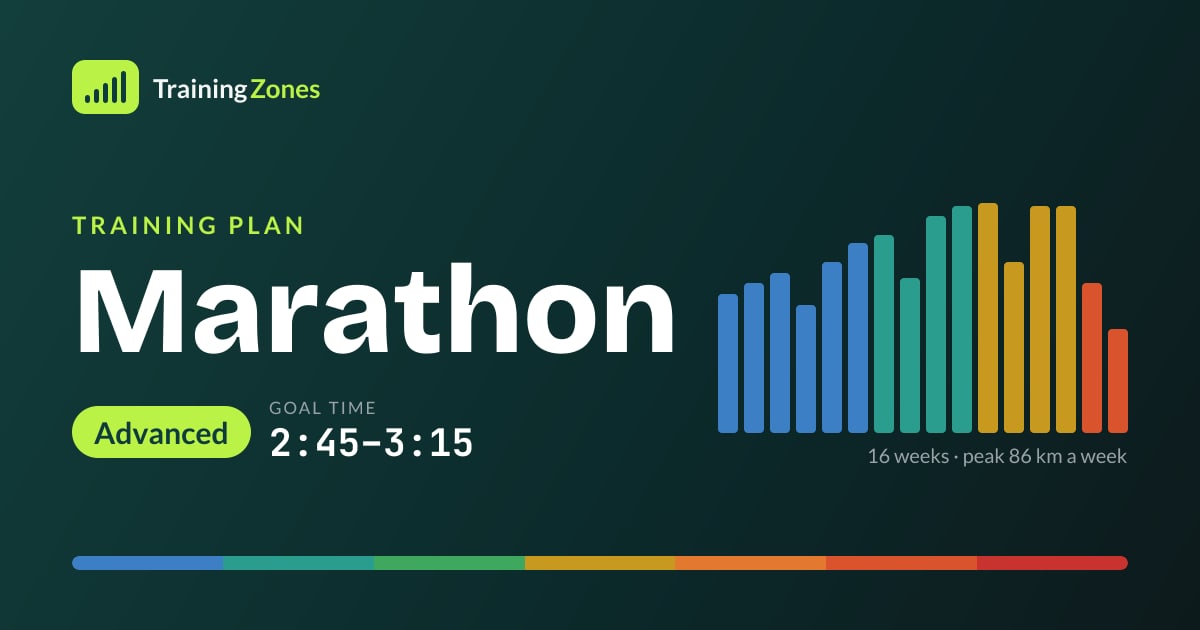
Advanced Marathon Training Plan: 16 Weeks for Sub-3 Runners
A 16-week advanced marathon plan for 2:45 to 3:15 runners: six runs a week, peak 86 km, 34 km long runs with up to 16 km at marathon pace. Free.
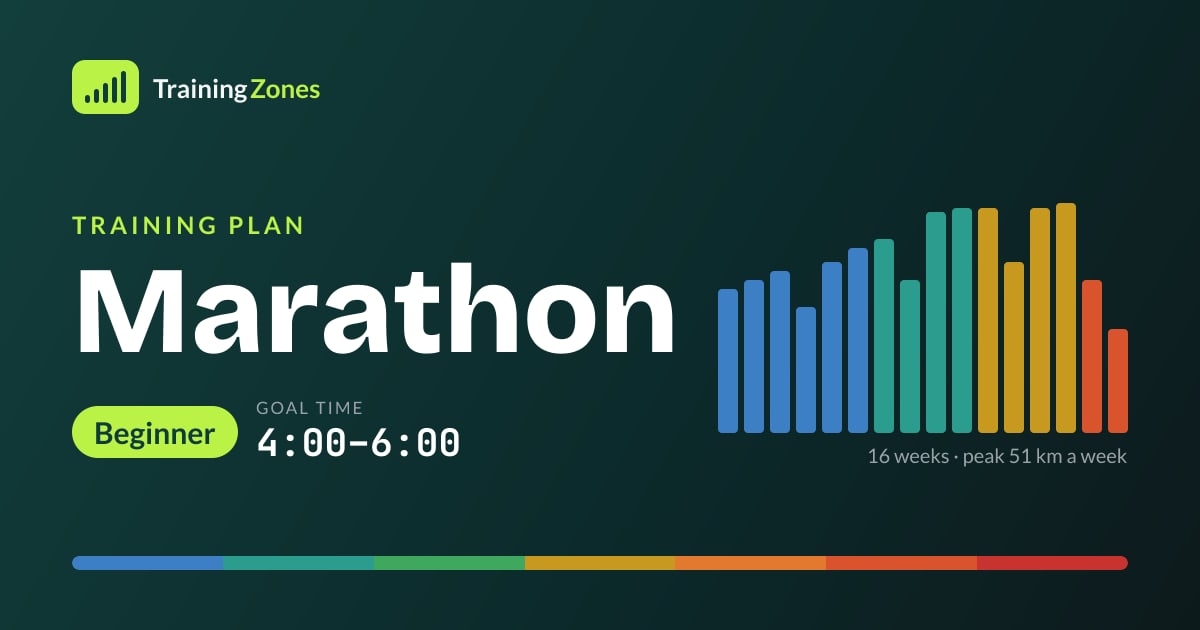
Beginner Marathon Training Plan: 16 Weeks, Four Runs a Week
A 16-week beginner marathon plan for 4:00 to 6:00 finishers: four runs a week, peak 51 km, long runs up to 23 km. Free, built from your own race time.
FAQ
Training zones, answered
Training zones split effort into intensity bands, each with a physiological purpose. Here is how to find and use yours.
What are training zones?
Training zones are intensity bands, usually three to seven, from easy aerobic work to hard anaerobic effort. Each zone targets a specific adaptation, so every session has a purpose.
How do I find my training zones?
Start from an anchor you can measure: maximum or threshold heart rate, FTP, or a recent race result. Enter it into the matching calculator. The Zone Finder above picks the right one.
Should I use heart rate, power, or pace?
Use what you can measure reliably. Power is most precise for cycling, pace for flat running. Heart rate works everywhere but lags on short efforts. Many athletes combine two.
How many training zones are there?
It depends on the model. Classic systems use three, five or seven zones. More zones give finer control, fewer are simpler to train by. All slice the same intensity spectrum.
Is TrainingZones really free?
Yes. Every calculator and result on TrainingZones is free, with no account and no email. Optional coaching with Coach Kalle funds the site. Zones are never gated.
From zones to a plan
Train with Coach Kalle and take your training to the next level.
An AI endurance and strength coach that reads your real training data, prescribes daily workouts with the reasoning, and learns as you go.